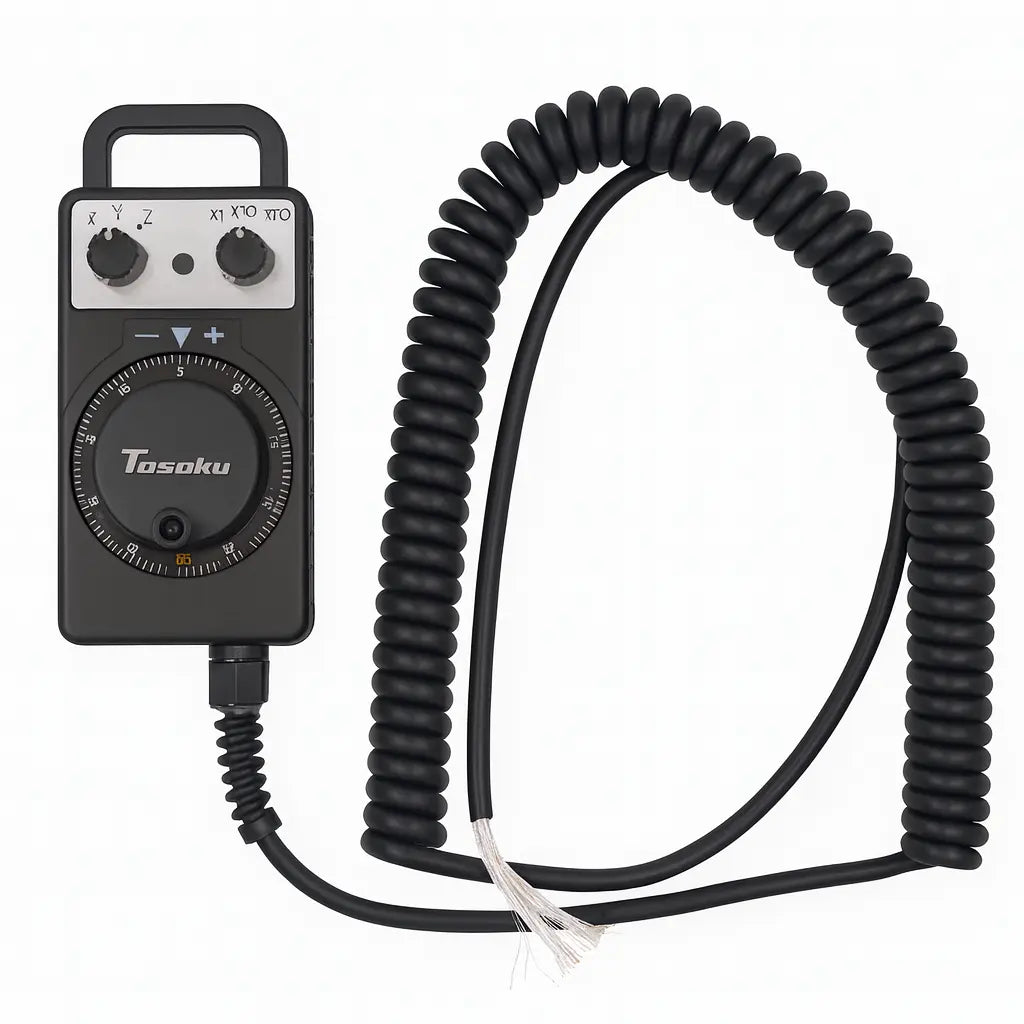
Tosoku HC115 handwheel encoder DC5V compatible Fanuc
Tax excluded. Shipping calculated at checkout
The Tosoku HC115 handwheel encoder is a precise pulse generator for CNC control panels with Manual Pulse Generator (MPG). It enables finely graduated manual axis adjustment and is ideally suited for machine tools in industrial applications.
Advantages of the Tosoku HC115 handwheel encoder
Precise manual axis control for CNC machines
Technical specifications – Tosoku HC115
Handwheel without plug
Tosoku
Tosoku HC115
Tosoku HC115
150x70mm
Precise manual axis control for CNC machines
Resistant to varying temperatures
Handwheels for machine tools

What are handwheels used for on machine tools?
Handwheels are used for the manual control of machine axes, especially during setup, positioning, and maintenance work. They enable precise and controlled axis movement.
When should a handwheel be replaced?
Replacement is advisable if the handwheel provides inaccurate signals, jerks, has play, is damaged, or executes axis movements with a delay. It should also be replaced if it fails during setup or axis referencing.
Can I install any handwheel in any CNC machine?
No. It must be compatible with the controller (e.g., Fanuc, Siemens, Heidenhain) and the connection (pin assignment, voltage, signal type). Mechanical dimensions such as diameter and mounting must also be correct.
Which machine manufacturers use such handwheels?
Handwheels are used in machines from Fanuc, DMG Mori, Mazak, Haas, Hurco, Okuma, Siemens, Heidenhain and many other machine tools.
Are there differences between mechanical and electronic handwheels?
Yes. Mechanical handwheels are used to directly move an axis, while electronic handwheel encoders (MPG) send signals to the controller, which then moves the axes.
What is a handwheel encoder (MPG)?
An MPG (Manual Pulse Generator) is an electronic handwheel that sends pulses to the CNC controller. This allows the axis to be moved precisely and in a controlled manner in small increments.
How do I identify the correct replacement type?
Important information includes the model number, control type, connections, pulse resolution (e.g., 25 or 100 PPR), and form factor. Nameplates or old part numbers can help with matching.
Other Fanuc spare parts